
Overview
While conducting research into a recent N-able N-central authentication bypass vulnerability (CVE-2026-18577), Rapid7 Labs discovered two new vulnerabilities affecting the latest version of N-central. When chained together, these two vulnerabilities allow a remote unauthenticated attacker to bypass authentication and create a new attacker-controlled System administrator account on an affected server.
CVE ID | Description | CWE | CVSSv4 |
Semicolon/Forwarded access-control bypass | |||
UserTwoFactorLogin authentication bypass |
Both CVE-2026-86206 and CVE-2026-86207 have been patched by the vendor via N-central 2026.3 Hotfix 3.
Product description
N-able N-central is an enterprise-grade Remote Monitoring and Management (RMM) platform designed for Managed Service Providers (MSPs) and IT departments to monitor, manage, and secure complex, large-scale networks from a centralized dashboard.
Credit
These vulnerabilities were discovered by Stephen Fewer, Senior Principal Security Researcher at Rapid7, and are being disclosed in accordance with Rapid7's vulnerability disclosure policy.
Technical analysis
CVE-2026-86206
N-central exposes its management interface (TCP 8443 by default) through Envoy, an edge proxy. Envoy passes accepted requests to Jetty, the Java web server that hosts N-central's application. The application gives requests from the loopback address (i.e. 127.0.0.1) more access than requests from a remote system. This design depends on Envoy, Jetty, and the N-central access filter all agreeing on which application path the client requested and whether the client is really local. The following request can make them disagree about both of these things:
POST /dms;/services/ServerUI HTTP/1.1
Forwarded: for="127.0.0.\1"
Content-Type: text/xml; charset=utf-8
SOAPAction: ""
The semicolon in the URI and backslash in the Forwarded value introduce a discrepancy when processing the request that leads to an access control bypass. Looking at Figure 1 below, we can see an overview of how these two values are processed during an incoming malicious request.
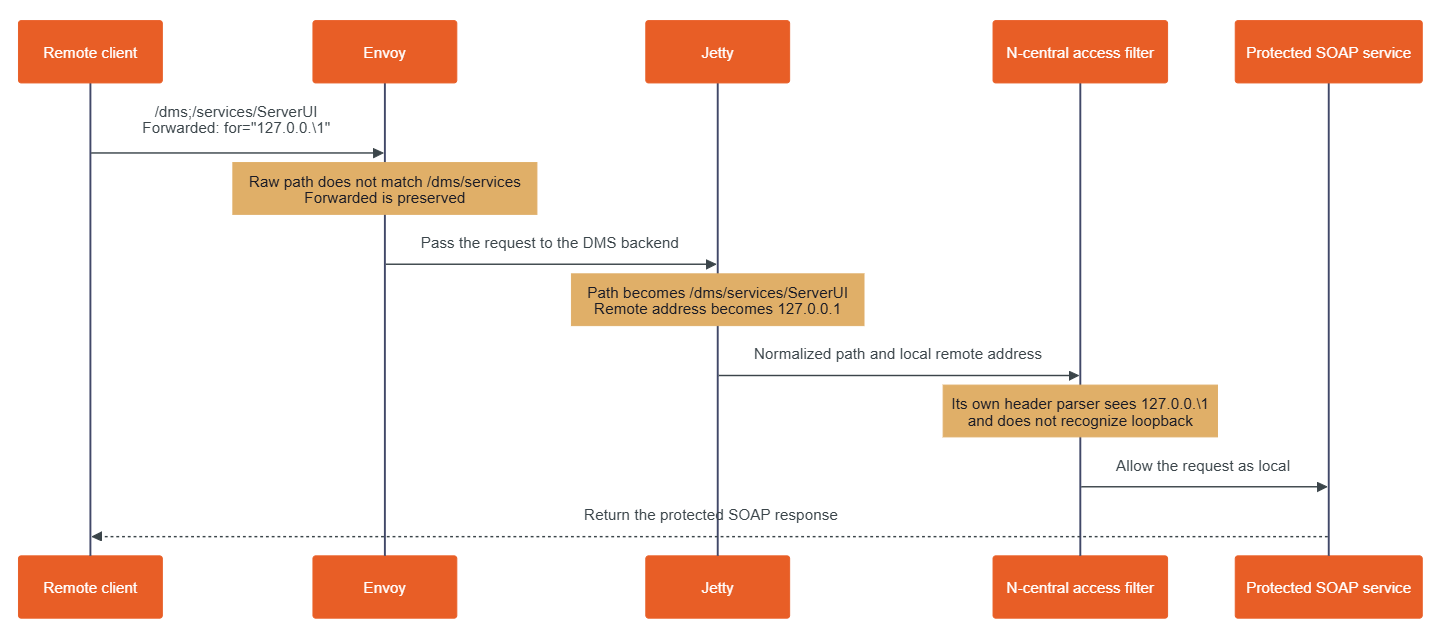
Figure 1: Processing a malicious request.
The semicolon gets the request past Envoy
The Envoy proxy rules come from the n-central-proxy-4.5.6-5 package. In /etc/opt/envoy/lds_intermediate.yaml, shown below (and edited for brevity), the management listener returns HTTP 403 for paths beginning with /dms/services or /internal/dms. A final catch-all rule sends other paths to the DMS application.
  # /etc/opt/envoy/lds_intermediate.yaml:953
  - match:
      prefix: /internal/dms
    # response-header boilerplate omitted
    direct_response:
      status: 403
      body:
        inline_string: Forbidden. No API access on the UI port.
  # ...
  - match:
      prefix: /dms/services
    # response-header boilerplate omitted
    direct_response:
      status: 403
      body:
        inline_string: Forbidden. No API access on the UI port.
 # ...
 # /etc/opt/envoy/lds_intermediate.yaml:1301
 # A final catch-all rule...
  - match:
      prefix: /
    route:
      cluster: dms
      timeout:
        seconds: 300
Envoy compares those prefixes with the path it received. The path /dms;/services/ServerUI does not begin with /dms/services, because the next character after /dms is a semicolon. It therefore reaches the catch-all route, passing the request from Envoy to Jetty.
Jetty interprets the path differently. The shipped jetty-http-9.4.56.v20240826.jar contains org.eclipse.jetty.http.HttpURI, and org.eclipse.jetty.util.URIUtil. Together, these classes treat text beginning with a semicolon as a path parameter and remove it when producing the decoded path used for servlet dispatch. As a result, Jetty turns /dms;/services/ServerUI into /dms/services/ServerUI. That decoded path then matches the Axis SOAP servlet mapping in /opt/nable/webapps/ROOT/WEB-INF/web.xml.
<!-- /opt/nable/webapps/ROOT/WEB-INF/web.xml -->
<!-- ...snip... -->

   <servlet>
        <servlet-name>DMSServlet</servlet-name>
        <servlet-class>org.apache.axis.transport.http.AxisServlet</servlet-class>
    </servlet>
    <servlet-mapping>
        <servlet-name>DMSServlet</servlet-name>
        <url-pattern>/dms/services/*</url-pattern>
        <url-pattern>/internal/dms/services/*</url-pattern>
    </servlet-mapping>

    <servlet>
        <display-name>CXF Servlet</display-name>
        <servlet-name>CXFServlet</servlet-name>
        <servlet-class>org.apache.cxf.transport.servlet.CXFServlet</servlet-class>
        <load-on-startup>2</load-on-startup>
    </servlet>
    <servlet-mapping>
        <servlet-name>CXFServlet</servlet-name>
        <url-pattern>/dms2/services2/*</url-pattern>
        <url-pattern>/internal/dms/services2/*</url-pattern>
    </servlet-mapping>
Similarly, the same technique can be used to target the SOAP service via /internal;/dms/services2/ServerUI2. Jetty decodes it to /internal/dms/services2/ServerUI2, which matches the CXF SOAP servlet mapping. A single semicolon is sufficient to create the routing disagreement.
Reaching these servlet mappings puts the request at the protected SOAP interfaces that an exploit can leverage to establish an application session and later manage privileged objects, but the semicolon trick alone does not authorize the request. Without the crafted Forwarded header, Jetty retains the client's real remote address and N-central's ServletPathFilter denies access. Conversely, the header trick alone cannot help a request to the ordinary /dms/services/ServerUI or /internal/dms/services2/ServerUI2 path: Envoy returns HTTP 403 without forwarding that request to Jetty.
As such, an exploit needs both discrepancies; the semicolon to pass Envoy's path check and the header to pass N-central's local-request check.
The header makes the remote client look local
The Forwarded header tells an application about the original client behind a proxy. In a malicious request, the for value is quoted and contains a quoted-pair (\1):
Forwarded: for="127.0.0.\1"Under the HTTP quoted-string grammar, the backslash escapes the following character. Jetty's ForwardedRequestCustomizer, from jetty-server-9.4.56.v20240826.jar, applies that rule. It removes the backslash, reads the value as 127.0.0.1, and exposes that value to N-central as the request's remote address.
N-central then parses the original header a second time. Its parser is in com.nable.util.LocalHostUtils, from /opt/nable/webapps/ROOT/WEB-INF/lib/dmsservice-11.0.1-SNAPSHOT.jar. This parser removes the surrounding quotes but does not remove the backslash. It therefore checks 127.0.0.\1.
That string is not a valid IP address. LocalHostUtils.xffCheck() rejects an invalid value found in X-Forwarded-For, but its Forwarded branch rejects only values that it successfully recognizes as loopback. The below (abridged) decompilation shows the relevant branch:
// dmsservice-11.0.1-SNAPSHOT.jar
// com.nable.util.LocalHostUtils.xffCheck()

List<String> forwardedAddresses =
    LocalHostUtils.getForAddressesFromForwardedHeaders(httpRequest);

for (String addr : forwardedAddresses) {
    if (!LocalHostUtils.isLoopbackAddress(addr.trim())) continue; // <--- [1]
    // log the rejected loopback address
    return false; // <--- [2]
}
return true; // <--- [3]
When given the header value 127.0.0.\1, the isLoopbackAddress() call (at [1]) returns false (at [2]) because the value is invalid. The loop therefore continues and xffCheck() returns true (at [3]). In other words, an invalid Forwarded header value causes xffCheck to fail open. The final decision occurs in com.nable.server.ServletPathFilter, shown below.
// dmsservice-11.0.1-SNAPSHOT.jar
// com.nable.server.ServletPathFilter.isAllowedRequest()

boolean isAllowedRequest(HttpServletRequest httpRequest) {
    if (!LocalHostUtils.xffCheck(httpRequest)) { // <--- [4]
        return false;
    }
    if (LocalHostUtils.isLocalhost(httpRequest)) { // <--- [5]
        return true; // <--- [6]
    }
    String path = this.removeTrailingSlashes(httpRequest.getRequestURI());
    return this.pathFilterService != null
        && this.pathFilterService.isPathAllowed(path);
}
The first check asks whether a forwarding header is trying to claim a loopback address (at [4]). N-central's parser sees the invalid value 127.0.0.\1, does not recognize it as loopback, and allows it. The second check asks whether Jetty's remote address is local (at [5]). Jetty has already converted the same header value to 127.0.0.1, so this check succeeds. The filter returns true (at [6]) before consulting the normal remote-path allowlist.
CVE-2026-86207
By leveraging CVE-2026-86206 to reach the protected URI /dms/services/ServerUI, a SessionID returned by the Session.Hello SOAP operation (See the prior work by Horizon3 on leveraging the legacy SOAP API) can be generated. However, this SessionID is only a pre-login session. It proves that the request reached the local-only SOAP API via the access control bypass, but it does not yet identify an authenticated user. A separate authentication bypass vulnerability, in how legacy two-factor authentication operates, allows a pre-login session to become an authenticated session.
The method com.nable.server.ui.UserTwoFactorLogin, from dmsservice-11.0.1-SNAPSHOT.jar (shown below), binds a requested user ID (e.g. the builtin N-able Administrator account’s well known ID 1) to the session (at [1]) before it attempts legacy two-factor authentication (at [2]) . A normal authentication rejection removes that binding (at [4]), but if an exception occurs, this binding is left in place (at [3]).
// dmsservice-11.0.1-SNAPSHOT.jar
// com.nable.server.ui.UserTwoFactorLogin

   public final String twoFactorLogin(int sessionID, int userID, String password) throws RemoteException {
        String response = null;
        try {
            this.updateSession(sessionID, userID); // <--- [1]
            T_User user = this.getUser(userID);
            response = this.authenticate(user, password); // <--- [2]
            Trace.info((Object)this, (String)("2FA authentication response for user '" + user.getUsername() + "': " + response));
            if (response != null && "ACCESS_OK".equals(response)) {
                String audit = "TWO FACTOR LOGIN SUCCESSFUL: UserID [" + userID + "] successfully logged in.";
                this.addSessionAuditEntry(sessionID, audit);
            } else {
                String audit = "TWO FACTOR LOGIN FAILED: UserID [" + userID + "] attempted to login with invalid PIN.";
                this.addSessionAuditEntry(sessionID, audit);
                this.makeSessionInvalid(sessionID); // <--- [4]
            }
        }
        catch (RemoteException re) {
            throw re; // <--- [3]
        }
        catch (Exception ex) {
            throw DMSError.getFault((String)CommonError.GENERIC_ERROR.getCodeAsString(), (String)ex.toString(), (Throwable)ex); // <--- [3]
        }
        return response;
    }
N-central supports two distinct second-factor systems: legacy, profile-based authentication using an external AuthAnvil or RSA SecurID server, and native time-based one-time password (TOTP) “Two-Step Verification” using an authenticator application. Despite overlapping 2FA/MFA terminology in N-able’s documentation, com.nable.server.ui.UserTwoFactorLogin implements the former profile-based mechanism; it does not enforce the user’s native TOTP setting.
In a default installation, legacy two-factor processing raises an exception for several builtin identities used by N-central, as each of these identities lack a single legacy AuthAnvil or RSA 2FA profile association required by UserTwoFactorLogin. Specifically the following built-in identities can be leveraged via their known ID numbers.
User ID 1 (N-able Administrator)
User ID 50 (Product Administrator)
User ID 51 (N-able Support)
By creating a new pre-login session for any one of the above IDs, a SOAP call to User.TwoFactorLogin with a dummy password will achieve the authentication bypass, converting the pre-login session to a privileged SOAP session for that user. By using additional calls to the ServerUI2 SOAP endpoint, a new attacker-controlled System user account can be created.
Remediation
The vendor-supplied release of N-central 2026.3 Hotfix 3 (version 2026.3.1.13) remediates both CVE-2026-86206 and CVE-2026-86207. All versions of N-central prior to 2026.3.1.13 are vulnerable. Customers running affected on-premise N-central environments are urged to apply the latest update on an urgent basis, outside of normal patching cycles.
Customers using hosted N-central environments do not need to take action as the vendor has applied the needed updates.
For the latest remediation guidance, please see the vendor release notes and the vendor disclosure blog.
Rapid7 customers
Exposure Command, InsightVM, and Nexpose
Exposure Command, InsightVM and Nexpose customers will be able to assess their exposure to both CVE-2026-86206 and CVE-2026-86207, with authenticated vulnerability checks expected to be available in the September 8 content release.
Disclosure timeline
August 27, 2026: Rapid7 makes initial outreach to N-able who respond the same day.
August 28, 2026: Rapid7 provides a detailed technical analysis and exploit script to N-able, along with a proposed timeline for a coordinated disclosure.
September 5, 2026: N-able release N-central 2026.3 HF3 which fixes two of the vulnerabilities (CVE-2026-86206, CVE-2026-86207) reported by Rapid7.
September 7, 2026: Rapid7 contacts N-able requesting clarity on several issues. N-able responds the same day with requested information.
September 8, 2026: This disclosure for CVE-2026-86206 and CVE-2026-86207.