Managed Application Security Testing
Rapid7 provides the experts, technology, and processes needed to effectively identify exploitable application vulnerabilities with the context developers need to fix issues before they appear in production.
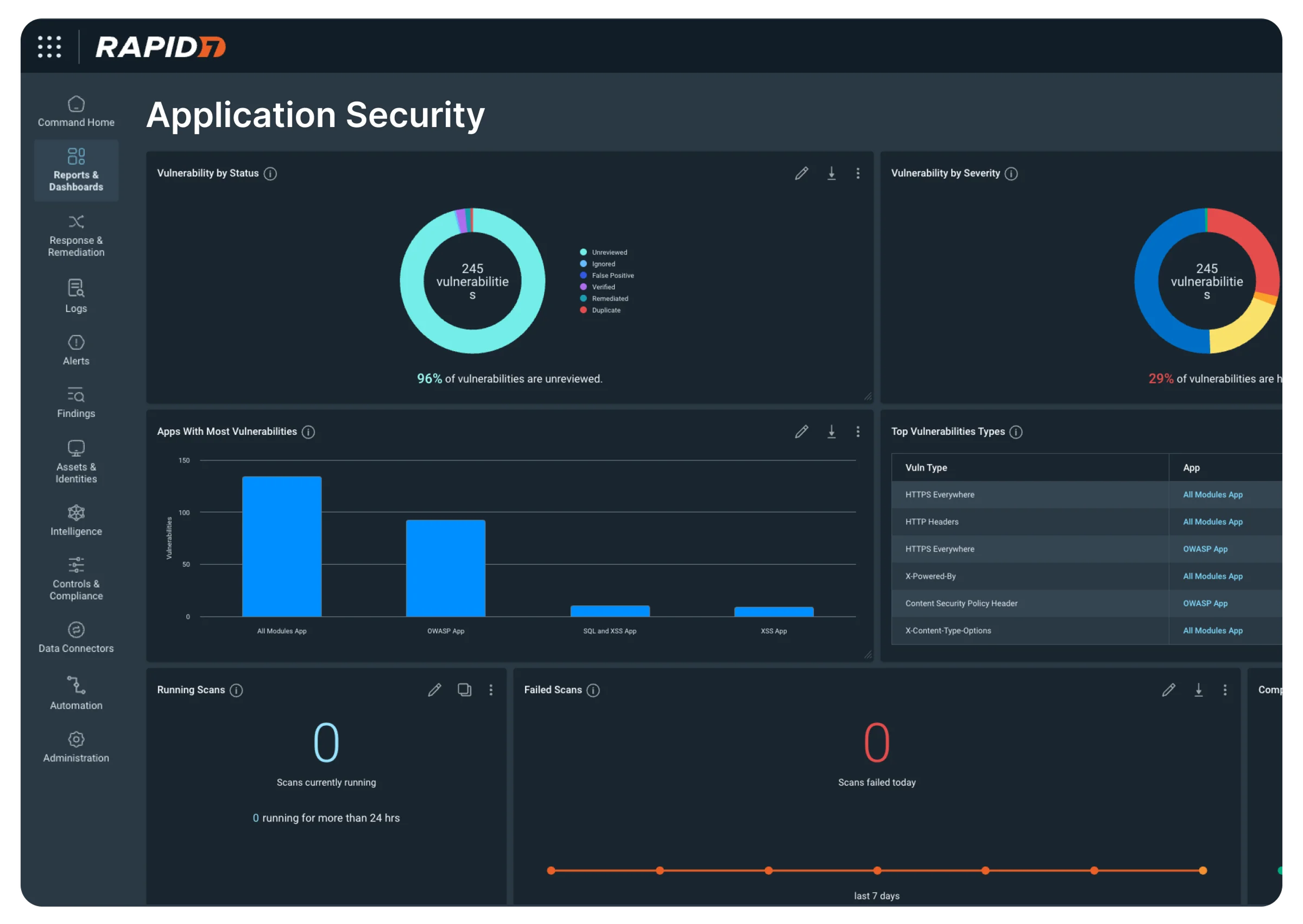
Applications are complex. Securing them doesn't have to be.
Eliminate exploitable application vulnerabilities with guidance from our application security experts and a multi-layered testing strategy that pairs monthly automated scanning with specialized, analyst-driven assessments.

Simplify application security
Reduce complexity and manage AppSec risk with guidance from a dedicated security advisor and experienced AppSec experts.

Simulate real-world attacks
Our experts will automatically assess your modern web applications and APIs with the same real-world TTPs that attackers use while layering in an annual, expert-led Business Logic Assessment to explore unique, intent-based risks.

Reduce noise, save time, secure faster
Managed AppSec provides superior coverage and risk reduction, delivering a consolidated view of both technical and logic-based vulnerabilities, freeing your team up for more priority security initiatives.
Simplify application security
Reduce complexity and manage AppSec risk with guidance from a dedicated security advisor and experienced AppSec experts.
Simulate real-world attacks
Our experts will automatically assess your modern web applications and APIs with the same real-world TTPs that attackers use while layering in an annual, expert-led Business Logic Assessment to explore unique, intent-based risks.
Reduce noise, save time, secure faster
Managed AppSec provides superior coverage and risk reduction, delivering a consolidated view of both technical and logic-based vulnerabilities, freeing your team up for more priority security initiatives.

If we managed application security tools internally, we’d see hundreds of alerts and have to parse through and figure out what’s what. Managed AppSec is a lot more manageable than having a static Excel sheet or a PDF of a hundred things to look into.
The power of hybrid testing
Rapid7 elevates the standard managed AppSec model by pairing high-frequency automated testing with an annual, analyst-led deep dive. This ensures your high-risk applications are protected from every angle.
| Managed DAST | Business Logic Assessment | |
|---|---|---|
| Primary goal | Foundational automation and baseline security | Identifying sophisticated flaws in how an app functions |
| Testing style | Automated, high-scale scanning of web apps and APIs | Specialized, analyst-driven exploration of workflows |
| Finding types | Injection flaws (SQL, XSS), CSRF, and misconfigurations | Privilege escalation, workflow bypass, and fraud logic |
| Frequency | Monthly | Annual |
| Output | Prioritized vulnerability data and actionable remediation guidance | Analyst-validated findings and proof-of-concept attack paths |
| Best for | Continuous risk baselining across your entire application portfolio | Focused, deep-dive validation of high-risk applications and critical workflows |
Protect your application's unique functional logic from real-world abuse
While DAST provides essential, ongoing coverage of the OWASP Top 10, our analysts provide an added layer of security by verifying that your application’s underlying logic cannot be abused.

Advanced authorization testing
Going beyond access controls to ensure standard users cannot escalate their privileges or manipulate roles.

Workflow integrity
Validating that critical business processes like checkouts, registrations, or approvals cannot be bypassed or manipulated.

Business rule resilience
Ensuring your core logic is hardened against real-world abuse.

Design-level validation
Analysts apply an understanding of application intent to identify subtle logic flaws in workflows like account recovery or session management.
Advanced authorization testing
Going beyond access controls to ensure standard users cannot escalate their privileges or manipulate roles.
Workflow integrity
Validating that critical business processes like checkouts, registrations, or approvals cannot be bypassed or manipulated.
Business rule resilience
Ensuring your core logic is hardened against real-world abuse.
Design-level validation
Analysts apply an understanding of application intent to identify subtle logic flaws in workflows like account recovery or session management.
Comprehensive compliance coverage
Automated DAST is a critical baseline for compliance, and pairing it with a Business Logic Assessment helps meet the specific manual testing requirements found in modern frameworks. Our analyst-driven testing provides documented evidence for:
PCI DSS 4.0
Satisfying strict requirements for secure development and regular testing of custom web applications. Analyst-led assessments provide the deep verification needed for access control mechanisms, ensuring users cannot manipulate roles, bypass payment workflows, or escalate privileges.
HIPAA
Strengthening your mandatory security risk analysis by uncovering functional loopholes that could expose electronic protected health information (ePHI). This ensures patient portals, APIs, and healthcare data pathways are hardened against sophisticated abuse.
SOC 2 & ISO 27001
Providing the clear, documented proof of system abuse prevention, data integrity, and technical vulnerability handling required by auditors.
OWASP ASVS
Directly targeting and preventing the abuse of business logic. Our specialists explicitly pressure-test functional workflows to ensure that design-level authorization rules hold up under real-world attacker methodologies.
PCI DSS 4.0
Satisfying strict requirements for secure development and regular testing of custom web applications. Analyst-led assessments provide the deep verification needed for access control mechanisms, ensuring users cannot manipulate roles, bypass payment workflows, or escalate privileges.
HIPAA
Strengthening your mandatory security risk analysis by uncovering functional loopholes that could expose electronic protected health information (ePHI). This ensures patient portals, APIs, and healthcare data pathways are hardened against sophisticated abuse.
SOC 2 & ISO 27001
Providing the clear, documented proof of system abuse prevention, data integrity, and technical vulnerability handling required by auditors.
OWASP ASVS
Directly targeting and preventing the abuse of business logic. Our specialists explicitly pressure-test functional workflows to ensure that design-level authorization rules hold up under real-world attacker methodologies.
Secure modern web applications
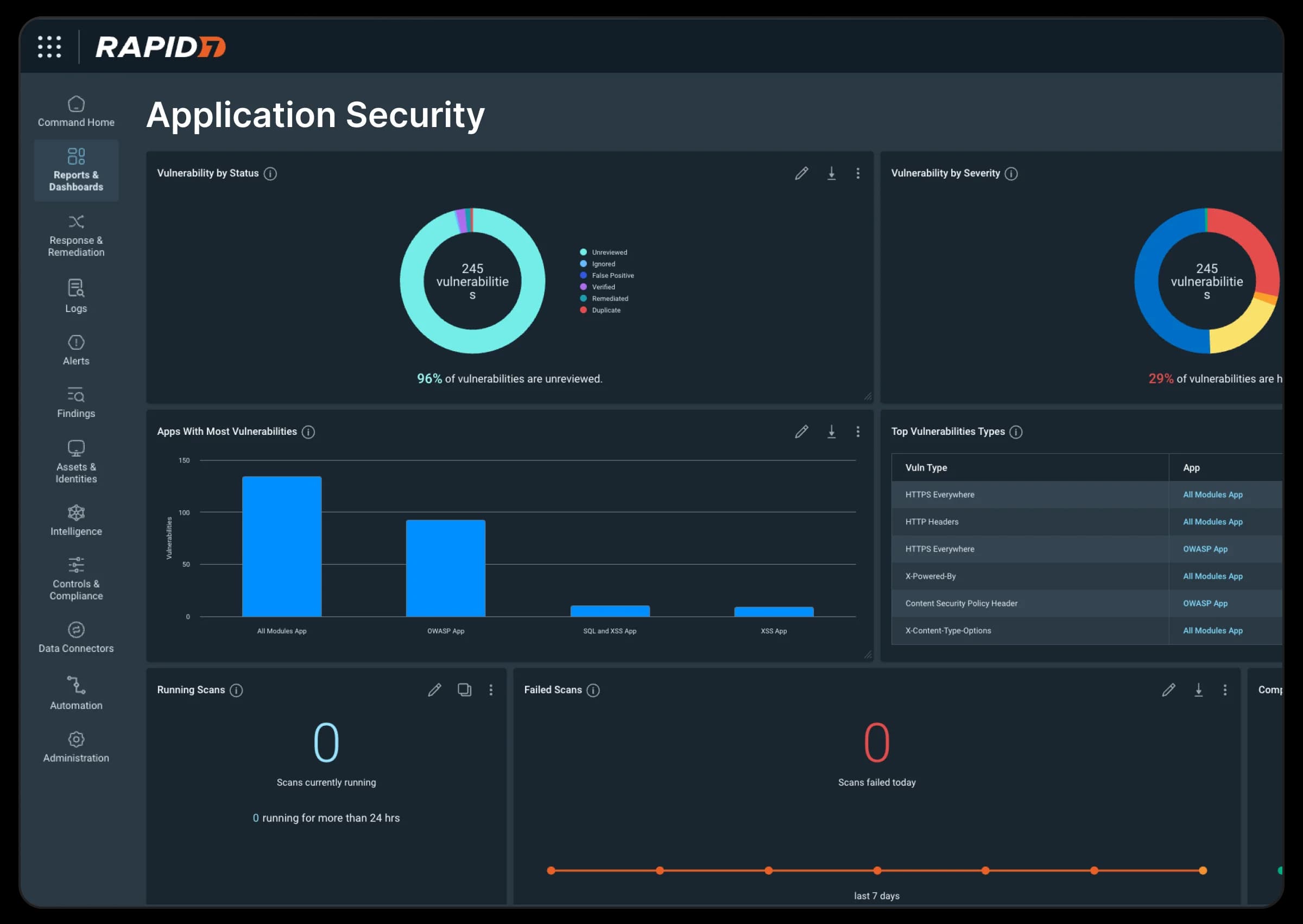
The underlying Dynamic Application Security Testing (DAST) technology behind Managed AppSec and InsightAppSec helps security teams to accurately and reliably assess modern web apps and APIs for potential vulnerabilities like SQL injection, XSS, and CSRF. Our team uses InsightAppSec’s ability to assess and report on how your web app security stands up to attackers and any potential compliance risk you might face.
Frequently Asked Questions