Incident Command
Rapid7 SIEM vs. Competitors
Evaluating next-gen SIEM platforms? Rapid7 Incident Command combines SIEM, ASM, SOAR, DFIR, and threat intelligence into one AI powered experience that unifies detection, investigation, and response. It helps security teams reduce noise, see meaningful signals earlier, and act with clarity across their environment.
Compare Rapid7 to leading platforms
Explore focused comparisons to support your evaluation

See deeper with threat aware context
Expand visibility and curate threat intelligence to connect attacker threat behavior directly to your SIEM workflow.

AI-powered SIEM built for analysts
Apply agentic AI workflows and processes with a natural language interface for log search queries.

Unified detection and response, simplified
Bring SIEM, SOAR, DFIR, and attack surface context together in one place with built-in automation and native MITRE ATT&CK® coverage.
See deeper with threat aware context
Expand visibility and curate threat intelligence to connect attacker threat behavior directly to your SIEM workflow.
AI-powered SIEM built for analysts
Apply agentic AI workflows and processes with a natural language interface for log search queries.
Unified detection and response, simplified
Bring SIEM, SOAR, DFIR, and attack surface context together in one place with built-in automation and native MITRE ATT&CK® coverage.

Rapid7’s SIEM is unlike anything else on the market. That was one of the attractive things, not having to deal with patching and updating it and looking after it and all sorts of other things that become a pain. Having that capability was great.

Scale SecOps with AI-powered next-gen SIEM
Explore Rapid7 SIEM’s coverage boost
Exposure management requires unified coverage across internal, cloud, and external attack surfaces. Many platforms rely on separate scanning tools or disconnected modules, which can create gaps and slow response. Exposure Command brings hybrid visibility, context, and action together to help security teams move faster with fewer tools.
| Capability | Rapid7 Incident Command | Other SIEMs |
|---|---|---|
| Cloud native SIEM, SOAR, and UBA | Unified in one platform | Often separate modules or add ons |
| AI triage and agentic workflows | Automates triage and investigation | Rules based or limited automation |
| MITRE ATT&CK mapped detections | Curated and continuously updated | Varies by vendor |
| Integrated DFIR (Velociraptor) | Included for investigation and evidence collection | Rare, usually external or add on |
| Transparent, asset based pricing | Predictable and aligned to environment size | Ingestion based with variable monthly cost that often exceeds budget |
| Fast time to value | SaaS deployment with guided onboarding | Longer setup and tuning cycles |
| Integrated attack surface management | Full attack surface insight with external and internal context | Separate ASM tools or no external visibility |
| Integrated threat intelligence | Curated threat intelligence from Intelligence Hub and Rapid7 Labs | Limited feeds or external add ons |
Get started with Rapid7 Incident Command
Incident Command delivers AI powered detection and response for the modern SOC. It helps teams reduce noise, consolidate tooling, and see the signals that matter across cloud, endpoint, identity, and external environments. Access additional resources to support your SIEM review.
IDC MarketScape: Worldwide SIEM for Enterprise 2024 Vendor Assessment
Rapid7 has been named a Leader in the IDC MarketScape: Worldwide SIEM for Enterprise 2024 Vendor Assessment
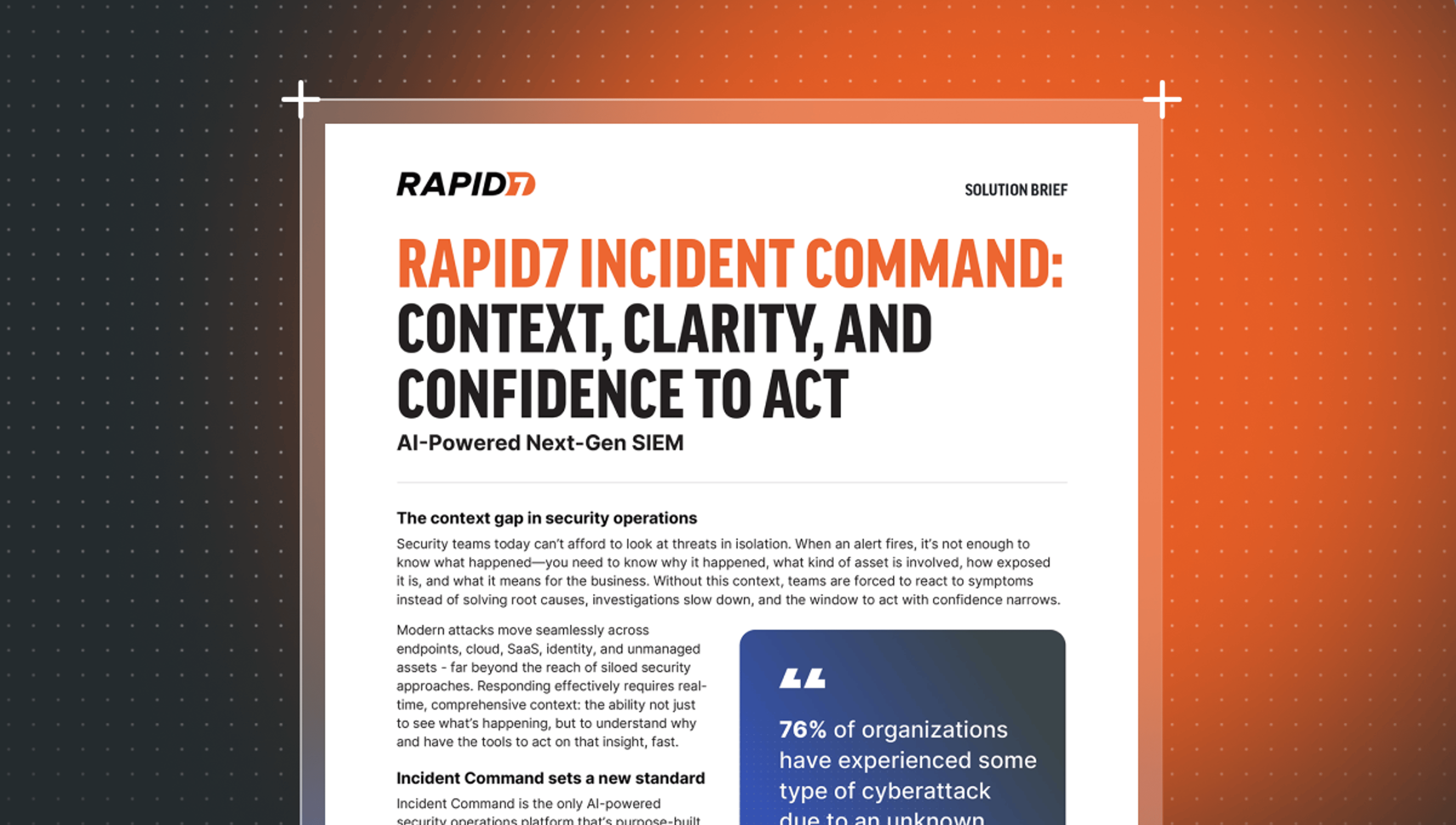
Incident Command Solution Brief
Explore how structured incident command enhances communication, improves decision-making, and drives faster resolution across your security operations.
A SIEM system collects, normalizes, and analyzes log and event data from across an organization’s digital environment to detect and respond to potential security threats. It provides visibility into activity across networks, users, and devices, correlating data to identify suspicious behavior, support investigations, and meet compliance requirements.
Rapid7 Incident Command ingests data across cloud, endpoint, and identity systems, then applies AI-powered technology to detect, prioritize, and automate response. Its industry-leading SIEM capabilities combine attack surface management (ASM), behavioral analytics, threat intelligence, and SOAR integration in a single solution with unified visibility, enabling security teams to act on critical insights across the entire threat attack surface in real time.
Unlike traditional SIEMs that rely on manual correlation and static rules, Rapid7 Incident Command uses agentic AI trained on years of SOC data to automate triage, enrich alerts with context, and recommend next steps. It also combines attack surface management (ASM), enabling insight into the entire threat attack surface and delivering a unified, adaptive detection and response experience across your entire security ecosystem.
Rapid7’s next-gen SIEM helps eliminate alert fatigue by using AI-powered triage to automatically classify 99.93% of benign alerts, dramatically reducing noise and manual workload for weary analysts. By enriching every alert with attack surface context, user behavior analytics, and threat intelligence, analysts can focus on the highest-priority risks. This intelligent automation not only improves accuracy and efficiency but also restores analyst confidence and capacity to respond quickly to real, actionable threats.
Yes. Rapid7 Incident Command offers nearly 300 native integrations across cloud, network, endpoint, and identity tools. Its open, ecosystem-agnostic design enables seamless data correlation with existing platforms like CrowdStrike, SentinelOne, and Microsoft Defender without vendor lock-in.
Rapid7’s next-gen SIEM uses transparent, asset-based pricing instead of complex ingestion models common among other leading SIEM providers. This ensures predictable costs, faster time to value, and flexible scalability as your data grows, eliminating budget surprises often associated with high-volume log management.
Rapid7 Incident Command combines continuous visibility, curated MITRE ATT&CK® detections, and AI-assisted investigation to shorten mean time to detect (MTTD) and respond (MTTR). Automated enrichment and guided workflows help analysts move from alert to containment in minutes, not hours.